Editorial performance, internationalization and scholarly infrastructure development of JGEOR during its first month of publication
First-Month Progress Report | 13 August – 13 September 2026
Author: Elnur Arifzade (Editorial Office)
The Journal of Green Economy and Optimization Research (JGEOR) has completed its first month of publishing activity with measurable growth in research output, international participation, editorial workload, readership and scholarly infrastructure. Between 13 August and 13 September 2026, JGEOR published 24 research articles across two regular issues and one special issue. The journal began with Volume 1, Issue 1 - August 2026, continued with its September issue, and subsequently developed the EcoNova Special Issue, dedicated to interdisciplinary research at the intersection of economy, ecology, innovation and sustainable development. JGEOR operates as a peer-reviewed, fully open-access journal, with published content distributed under the Creative Commons Attribution 4.0 International licence.
International participation developed rapidly during this initial period. Published and processed contributions have represented researchers from Azerbaijan, Kazakhstan, Uzbekistan, Sri Lanka, India, Germany, Cameroon and Great Britain, giving the journal an author reach spanning eight countries within its first month. External peer review has also been deliberately internationalized: manuscripts proceeding through review have been evaluated by reviewers representing at least three countries per article, complementing JGEOR's formal double-blind peer-review model. During its first month, JGEOR also expanded its international institutional network through cooperation with the Institute for Peace and Dialogue (IPD), Switzerland. The cooperation supports academic, institutional and educational engagement, research networking and opportunities for future joint initiatives. This partnership forms part of JGEOR’s broader strategy to strengthen its international academic connections alongside the development of its editorial, publishing and research-discovery infrastructure.
The first-month editorial pipeline comprised 59 manuscripts at different stages. Of these, 24 articles were published (40.7%), 5 manuscripts were accepted and scheduled for the 1 October issue (8.5%), 8 remained under peer review (13.6%), and 4 were undergoing author revision (6.8%). During the same period, 18 manuscripts were rejected (30.5%), reflecting the journal's use of editorial screening and external review rather than automatic acceptance of submissions. Among manuscripts already reaching a final publish/accept/reject outcome, the rejection share was approximately 38.3%. Reader engagement also developed quickly. During the reporting period, the JGEOR website recorded 4,095 individual visitors. In parallel, the Editorial Office received 78 calls through the journal's support line and 41 support emails, representing 119 direct author and reader support interactions during the journal's first month.
Table 1. JGEOR first-month editorial, publication and engagement indicators (15 August–13 September 2026)
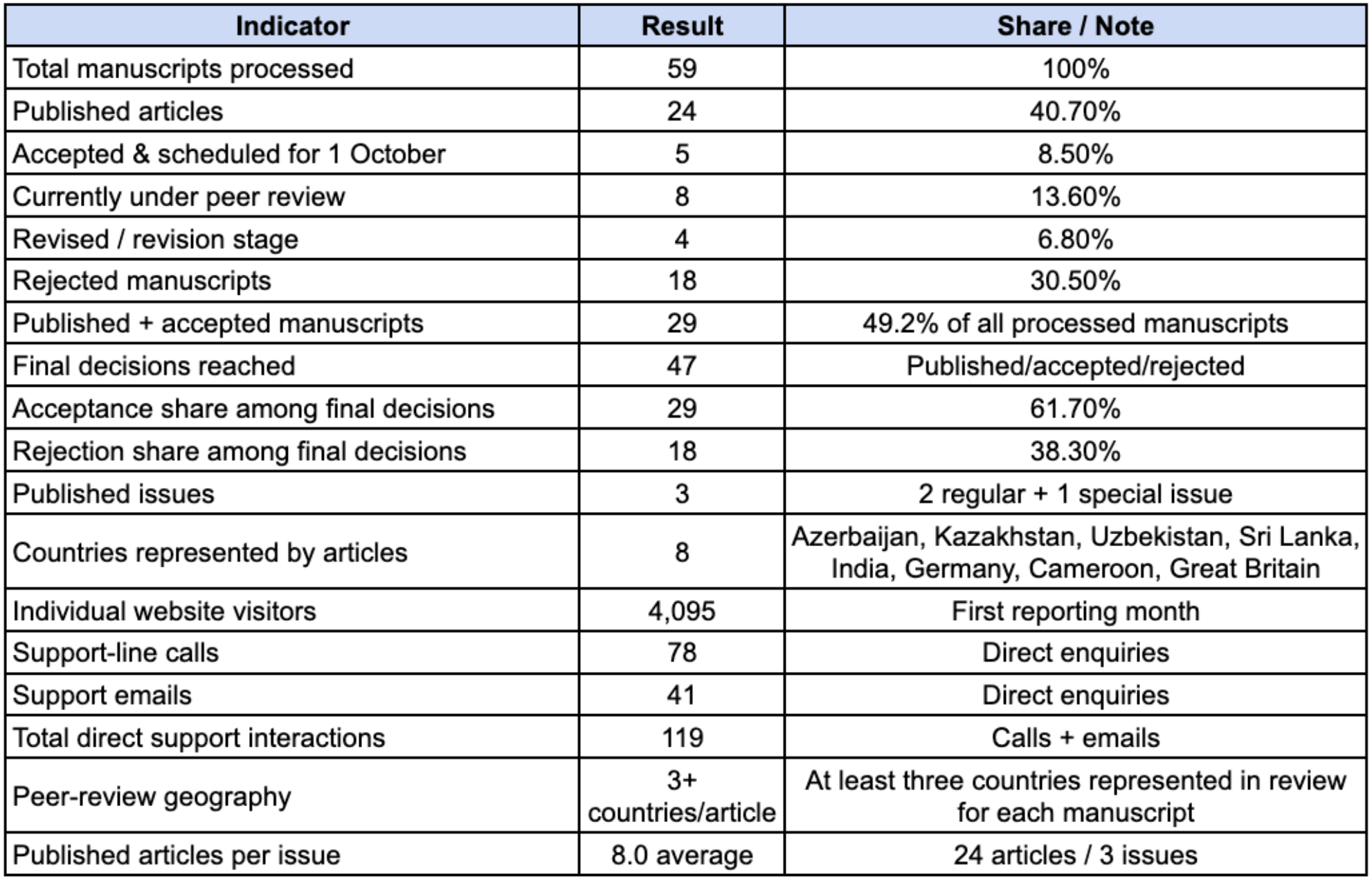
These figures indicate that almost half of all manuscripts processed during the reporting period had already reached publication or formal acceptance, while a further 20.3% remained in active peer-review or revision stages. Among manuscripts for which a final editorial outcome had been reached, 61.7% were accepted or published and 38.3% were rejected.
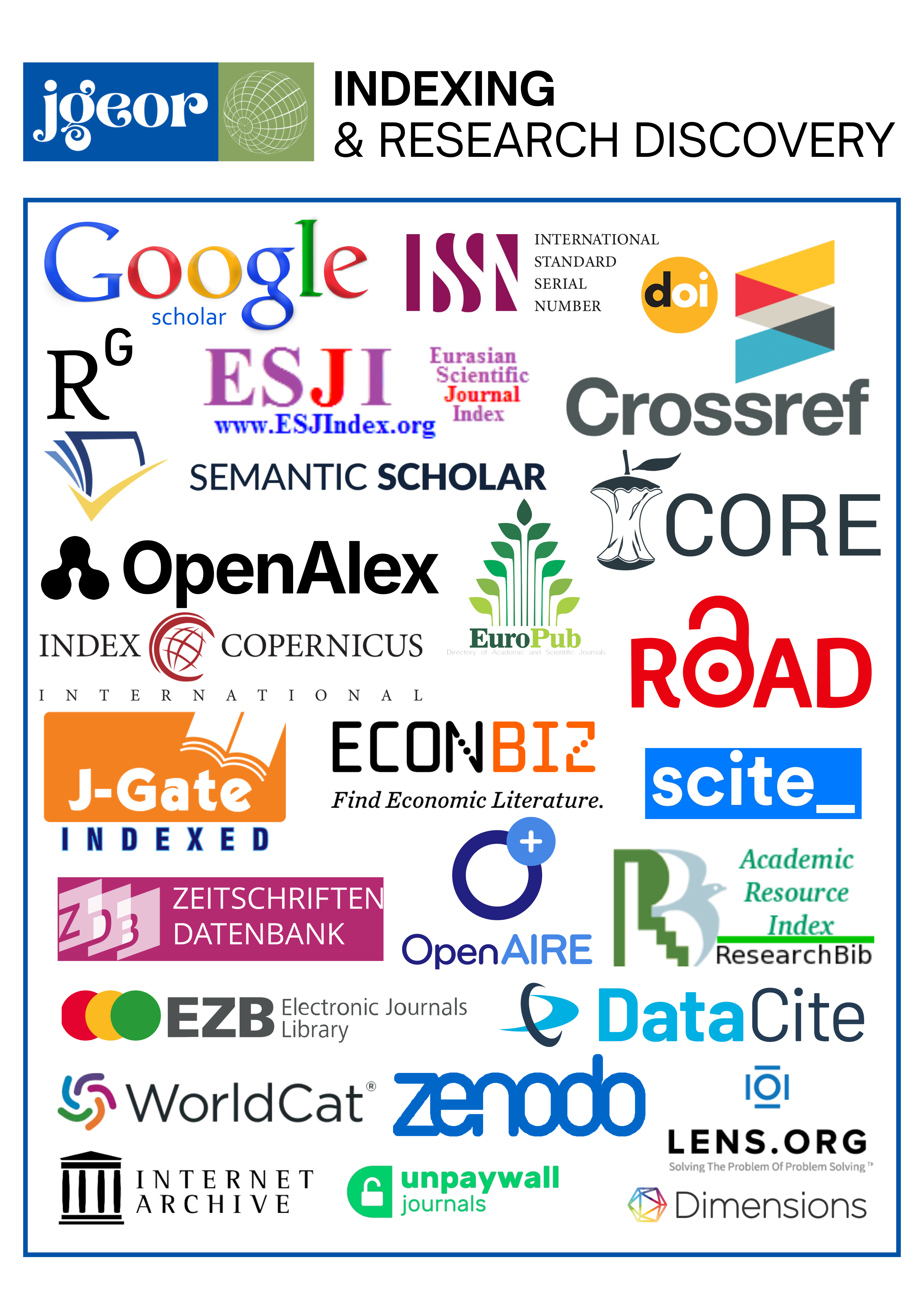
JGEOR also established several core components of its international publishing infrastructure. On 10 September 2026, the journal received its official e-ISSN 3136-7968, providing a standardized international identity for its electronic serial publication. The publisher also became a Crossref member, and JGEOR received the DOI prefix 10.68210 and journal-level DOI 10.68210/jgeor, establishing the infrastructure for direct Crossref DOI registration and structured scholarly metadata dissemination. The EcoNova special issue has been assigned the DOI 10.68210/jgeor.v1si1. Research visibility has expanded through a broad scholarly discovery ecosystem. JGEOR's current indexing, discovery, identification, cataloguing, repository and scholarly-information portfolio includes Google Scholar, ResearchGate, ISSN, DOI, Crossref, ESJI – Eurasian Scientific Journal Index, CiteFactor, Semantic Scholar, OpenAlex, CORE, EuroPub, Index Copernicus International, ROAD, J-Gate, EconBiz, Scite, ZDB – Zeitschriftendatenbank, OpenAIRE, ResearchBib – Academic Resource Index, EZB – Electronic Journals Library, DataCite, WorldCat, Zenodo, Lens.org, Internet Archive, Unpaywall Journals and Dimensions. These platforms perform different functions—ranging from indexing and article discovery to identifier registration, library cataloguing, metadata aggregation, repositories and scholarly profiles—and therefore should not be interpreted as equivalent types of indexing services.

Figure 1. International academic outreach during JGEOR’s first month: Editor-in-Chief Ulvi Mammadov at CERN, Meyrin, Switzerland, 1 Esplanade des Particules, 1217 Meyrin, Switzerland, located near Geneva.
According to Ulvi Mammadov, Editor-in-Chief of JGEOR and Head of the Green Economy and Optimization Research Lab (Institute), the journal’s first month demonstrates how quickly a new scholarly platform can develop when editorial quality, international cooperation, open access and research visibility are advanced in parallel.
“Our objective is not simply to increase the number of publications, but to build JGEOR as a reliable and internationally connected academic platform where researchers from different countries can publish, review and exchange knowledge within a transparent editorial environment.”
- Mammadov noted.
Several of these developments have already been formally documented. JGEOR is indexed in J-Gate, which provides discovery across more than 100,000 journals and over 100 million scholarly articles; it is catalogued in ZDB and listed as an open-access journal in EZB; and it has joined CORE as a Starting Member, with journal metadata and full-text content being processed through CORE's harvesting infrastructure. Research-integrity infrastructure has advanced as well. JGEOR has achieved 100% Crossref Similarity Check eligibility (3/3 eligible deposits), enabling the journal to proceed with access to the Crossref–iThenticate Similarity Check service. This will strengthen pre-publication similarity screening alongside editorial assessment and peer review. In addition, a formal application for inclusion in the Directory of Open Access Journals (DOAJ) was submitted on 11 September 2026 and is currently awaiting evaluation.
The journal's first month therefore represents more than the publication of its first articles. In a short period, JGEOR has established an active international submission and peer-review workflow, published 24 articles, reached readers and authors across multiple countries, created DOI and ISSN infrastructure, expanded library and research-discovery exposure, and developed the foundations for stronger publication-ethics and similarity-screening procedures.
The next phase will focus on the 1 October 2026 regular issue, for which five articles are already accepted and scheduled, the continued development of the Green Horizons Special Issue, broader international authorship and reviewer participation, completion of the Crossref Similarity Check activation process, and continued expansion of appropriate scholarly indexing, cataloguing and discovery coverage.