Combined anthropogenic and climate pressures on the Kura River and their implications for water security, ecosystem sustainability and green economic resilience
DOI:
https://doi.org/10.68210/jgeor.a55Keywords:
anthropogenic pressure, climate change, ecosystem sustainability, green economic resilience, Kura RiverAbstract
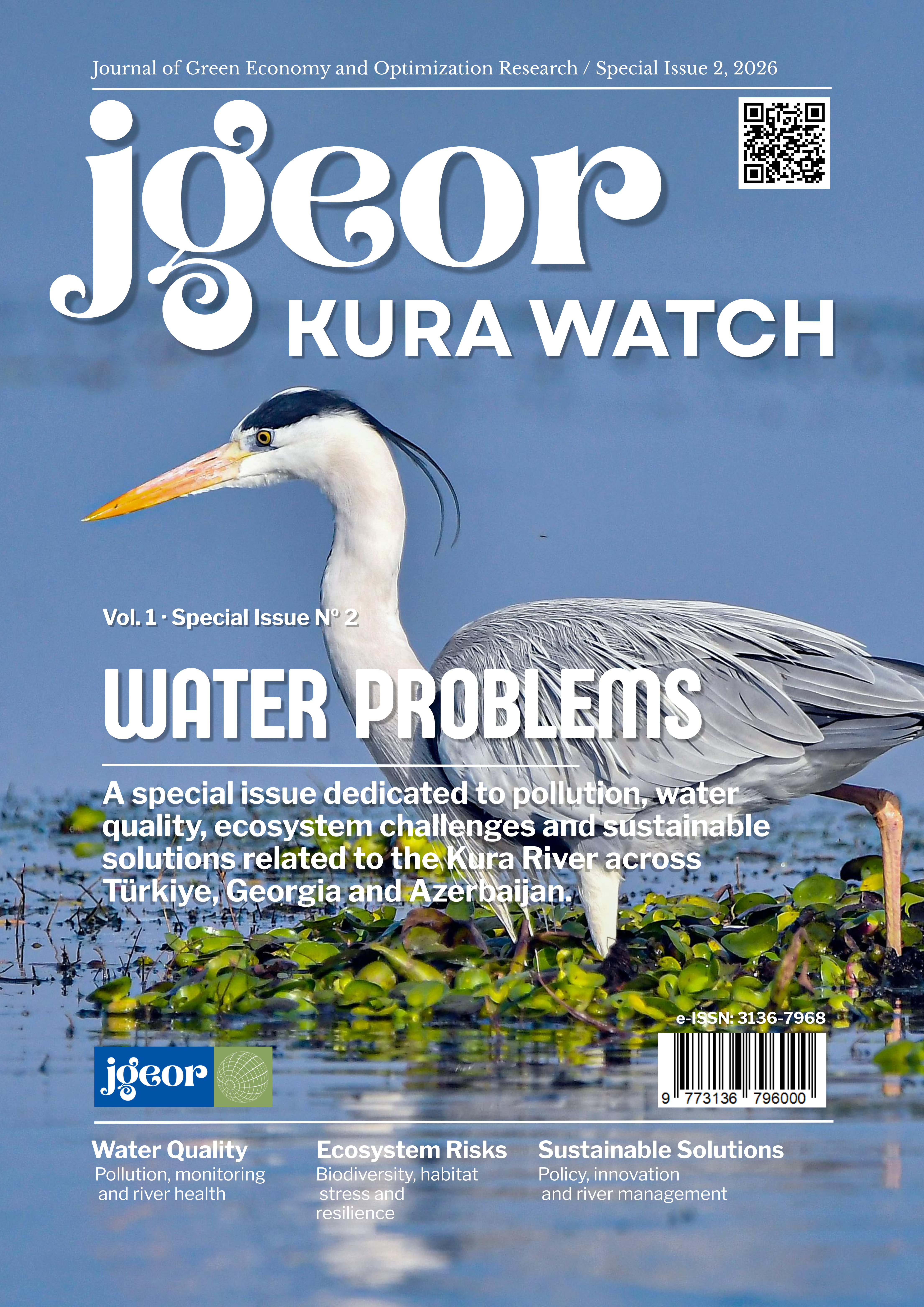
The Kura River is a strategic water artery for Azerbaijan, supporting drinking-water supply, irrigated agriculture, energy production and aquatic and riparian ecosystems. This study integrates two independently prepared 2026 research projects to examine how anthropogenic pressures and climate-related water stress interact and what these interactions imply for water security, ecosystem sustainability and green economic resilience. The first source project used desk research, official statistics, visual observation, teacher interviews and map-based comparison to assess human impacts on the river. The second combined desk research with an exploratory survey of 25 students and family members. Survey results showed that 92% considered the Kura important for Azerbaijan, 84% recognized ecological problems, 76% reported practicing water conservation and 96% supported stronger protection measures. The source materials consistently identified inefficient irrigation, untreated wastewater, solid waste, declining water availability, climate variability and riparian degradation as interconnected pressures. Recent official and scientific evidence supports the direction of these concerns, although one source-project estimate of a 35–40% flow decline could not be independently verified from the underlying data and is therefore not treated as a measured result. The analysis shows that water efficiency, pollution control, climate adaptation, riparian restoration and transboundary cooperation are not only environmental priorities but also elements of green economic resilience because they protect agricultural productivity, ecosystem services and the reliability of water-dependent livelihoods. Integrated river-basin management is therefore essential for aligning ecological protection with resource-efficient development.
Downloads
References
Aliyev, E., & Abduyev, M. (2025). Quality trend of Kura River in Azerbaijan by major ion concentration. Discover Water, 5, 82. https://doi.org/10.1007/s43832-025-00219-9
Grey, D., & Sadoff, C. W. (2007). Sink or swim? Water security for growth and development. Water Policy, 9(6), 545–571. https://doi.org/10.2166/wp.2007.021
Han, J., Kim, M., Mammadov, Z., Lee, S., Elzinga, E. J., Mammadov, G., Hwang, W., & Ro, H.-M. (2024). Synergistic effect of climate change and water management: Historical and future soil salinity in the Kur-Araz lowland, Azerbaijan. Science of the Total Environment, 907, 167720. https://doi.org/10.1016/j.scitotenv.2023.167720
Ministry of Ecology and Natural Resources of the Republic of Azerbaijan. (n.d.). Surface water resources. https://eco.gov.az/az/fealiyyet-istiqametleri/hidrometeorologiya/yerustu-su-ehtiyatlari
President of the Republic of Azerbaijan. (2024). National Strategy on Efficient Use of Water Resources, 2024–2040. Approved by Presidential Order No. 320 of 10 October 2024. https://president.az/az/articles/view/67069
Republic of Azerbaijan. (2024). Initial National Adaptation Plan. United Nations Framework Convention on Climate Change. https://unfccc.int/sites/default/files/resource/2024_NAP_Azerbaijan.pdf
Suleymanov, F. (2025). The institutionalization of the Kura-Aras River Basin for effective management of water resources. International Journal of River Basin Management, 23(4), 675–685. https://doi.org/10.1080/15715124.2024.2363310
World Bank. (2023). Azerbaijan Country Climate and Development Report. World Bank Group. https://www.worldbank.org/en/country/azerbaijan/publication/country-climate-and-development-report-for-azerbaijan
World Bank. (2024). Azerbaijan: General water security assessment. World Bank Group.
World Bank. (2024). Azerbaijan - Transitioning to efficient water sector institutions and programs for addressing water security challenges. World Bank Group.
Downloads
Published
Issue
Section
Categories
License
Copyright (c) 2026 Journal of Green Economy and Optimization Research

This work is licensed under a Creative Commons Attribution 4.0 International License.
Copyright © The Author(s).
Authors retain copyright in their work and grant the Journal of Green Economy and Optimization Research (JGEOR) the right of first publication.
Articles published in JGEOR are distributed under the terms of the Creative Commons Attribution 4.0 International License (CC BY 4.0). This license permits use, sharing, adaptation, distribution, and reproduction in any medium or format, provided that appropriate credit is given to the original author(s) and the source, a link to the Creative Commons licence is provided, and any changes made are indicated.
Authors are responsible for obtaining permission to reproduce any third-party material that is not covered by the article's Creative Commons licence.