Transboundary pollution and ecological degradation in the Kura–Araz river system and their implications for water security and green economic resilience
DOI:
https://doi.org/10.68210/jgeor.a60Keywords:
green economy, Kura–Araz, transboundary pollution, water security, river basin managementAbstract
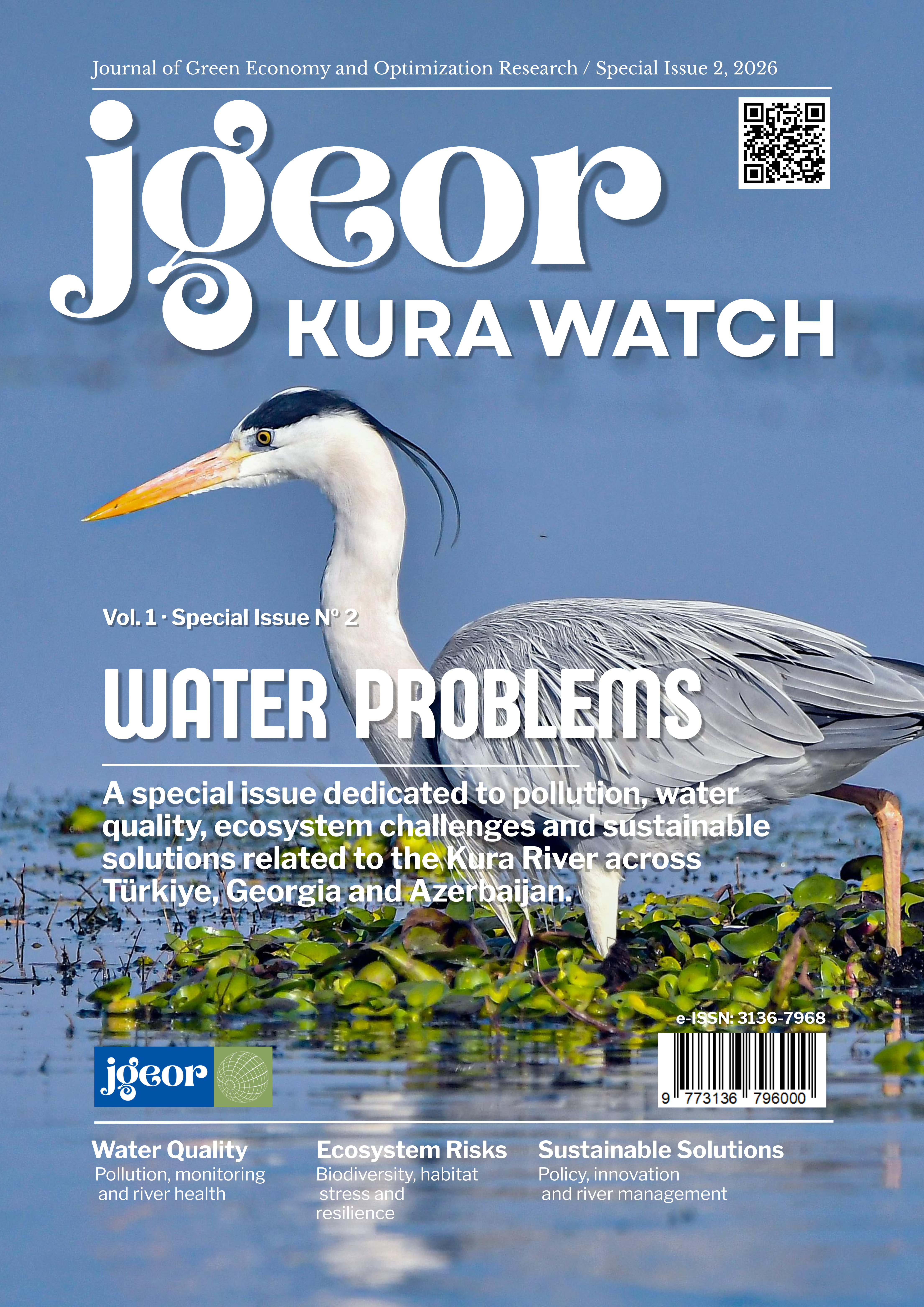
The Kura–Araz river system is central to Azerbaijan’s water security, irrigated agriculture, settlements, biodiversity and regional economic resilience. This study integrates two educational research projects that examined river pollution, declining water availability, biodiversity pressure and practical responses from complementary perspectives. The source materials were synthesized with peer-reviewed and institutional evidence and interpreted through water-security and green-economy frameworks. The combined evidence identifies a pressure chain that begins with transboundary and domestic wastewater, industrial and mining emissions, agricultural runoff, solid waste, flow regulation and climate-related water scarcity. Published studies confirm that the Kura–Araz system is exposed to spatially uneven metal pollution and that Azerbaijan depends heavily on transboundary inflows, while recent national water-sector assessments emphasize increasing scarcity and the need for more efficient institutions, monitoring and investment. The original student works also highlight biodiversity loss, degradation of riparian habitats, risks to fisheries and agriculture, and the importance of public awareness, riverbank protection and modern treatment systems. Economically, deteriorating water quality and quantity can increase treatment and monitoring needs, constrain irrigation, reduce ecosystem-service value and weaken rural and urban resilience. The study concludes that basin-scale monitoring, wastewater treatment, efficient irrigation, transboundary cooperation and environmental education should be treated as mutually reinforcing investments in natural capital and Azerbaijan’s green economic transition.
Downloads
References
Aliyev, E., & Abduyev, M. (2025). Quality trend of Kura River in Azerbaijan by major ion concentration. Discover Water, 5, 82. https://doi.org/10.1007/s43832-025-00219-9
European Union Water Initiative Plus (EUWI+). (2021). Draft river basin management plan for the Kura upstream of Mingachevir Dam river basin district. European Union Water Initiative Plus.
Ministry of Ecology and Natural Resources of the Republic of Azerbaijan. (2024). Monitoring report on transboundary rivers of Azerbaijan. Baku, Azerbaijan.
Suleymanov, B., Ahmedov, M., Safarova, K., & Steinnes, E. (2010). Metals in main rivers of Azerbaijan: Influence of transboundary pollution. Water, Air, & Soil Pollution, 213(1–4), 301–310. https://doi.org/10.1007/s11270-010-0385-1
United Nations Economic Commission for Europe. (2011). Second assessment of transboundary rivers, lakes and groundwaters. United Nations.
World Bank. (2022). Azerbaijan: Towards green growth—Issues note. World Bank.
World Bank. (2024). Azerbaijan: Transitioning to efficient water sector institutions and programs for addressing water security challenges. World Bank.
World Bank Group. (2023). Azerbaijan country climate and development report. World Bank. https://doi.org/10.1596/40622
Muradli, N. (2026). Çay suyunun çirklənməsi və onun ətraf mühitə təsiri [Educational research project]. Aghali School, Zangilan, Azerbaijan.
Asya, B., Mahira, A., & Sadaqat, M. (2026). Kür çayının ekoloji problemləri və onların həlləri [Educational research project]. Kürün səsi group, Baku, Azerbaijan.
Downloads
Published
Issue
Section
Categories
License
Copyright (c) 2026 Journal of Green Economy and Optimization Research

This work is licensed under a Creative Commons Attribution 4.0 International License.
Copyright © The Author(s).
Authors retain copyright in their work and grant the Journal of Green Economy and Optimization Research (JGEOR) the right of first publication.
Articles published in JGEOR are distributed under the terms of the Creative Commons Attribution 4.0 International License (CC BY 4.0). This license permits use, sharing, adaptation, distribution, and reproduction in any medium or format, provided that appropriate credit is given to the original author(s) and the source, a link to the Creative Commons licence is provided, and any changes made are indicated.
Authors are responsible for obtaining permission to reproduce any third-party material that is not covered by the article's Creative Commons licence.