The decline of the Kura River water level and the impacts of climate change, human activity and water management on environment and society in Azerbaijan
DOI:
https://doi.org/10.68210/jgeor.a78Keywords:
Kura River, climate change, water scarcity, water quality, water managementAbstract
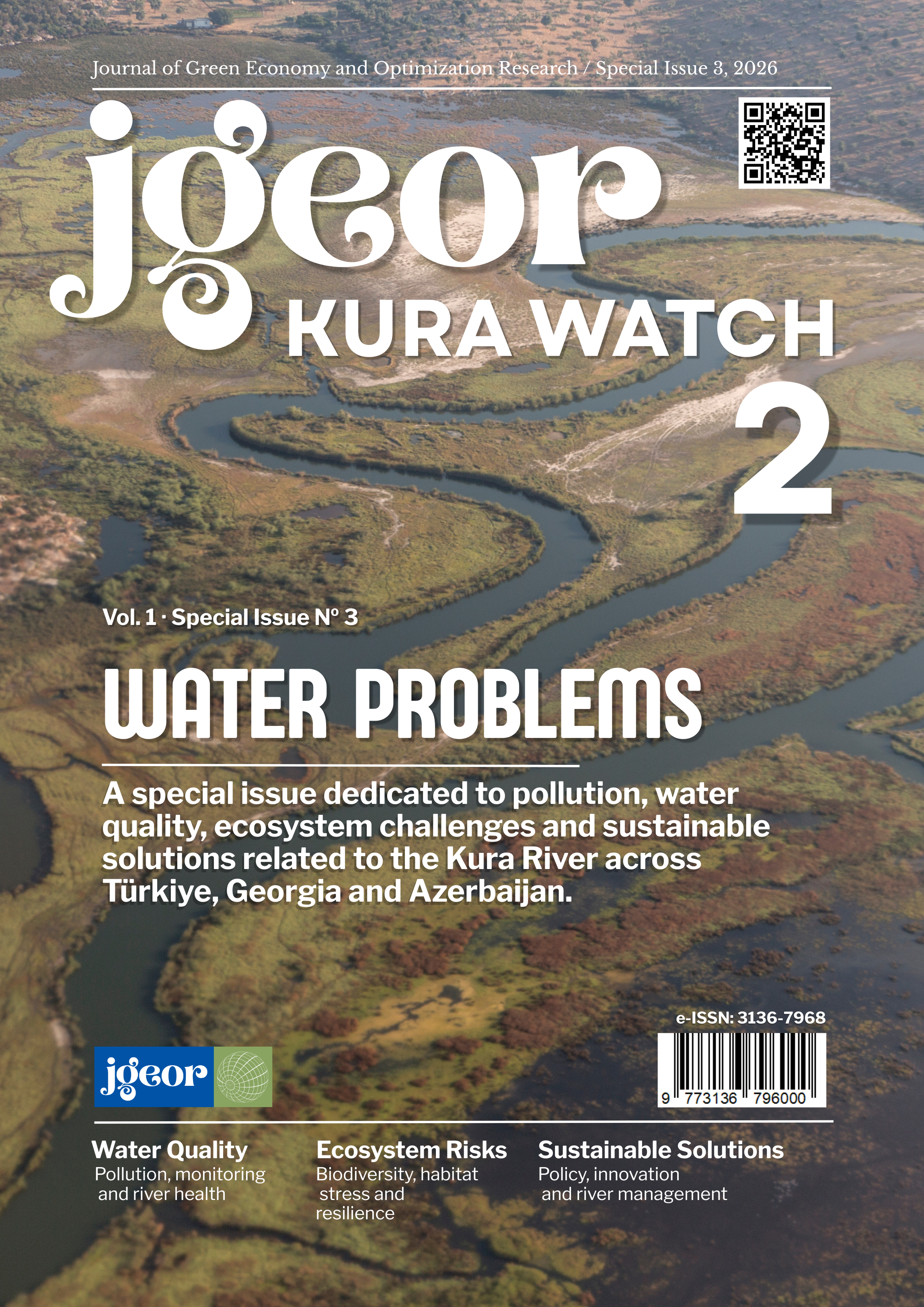
The Kura River is a transboundary water system whose quantity, quality, and ecological condition are closely connected to water security in Azerbaijan. This study develops an original school research project into a structured academic synthesis of the interacting causes and consequences of declining water availability in the Kura River. The analysis is based on secondary research using government and international reports, scientific literature, maps, photographs, and recent peer-reviewed studies. Three research questions guide the paper: how climate change, human activity, and water-management systems influence water availability; how pollution affects ecosystems and human use of the river; and why Tugay riparian forests are important for ecological resilience. The evidence indicates that water scarcity should not be attributed to a single driver. Climatic variability, drought and evaporative demand interact with irrigation withdrawals, conveyance losses, reservoir regulation, pollution, and transboundary management constraints. Water-quality deterioration further reduces the effective availability of water suitable for drinking, irrigation, ecosystems, and recreation. Riparian Tugay forests provide bank stabilization, habitat connectivity, and landscape functions, but depend on appropriate flow and groundwater conditions. The study concludes that efficient irrigation, leakage reduction, wastewater treatment, monitoring, ecosystem restoration, nature-based solutions, and basin-scale cooperation should be pursued together. These measures also have green-economy relevance because they protect natural capital, reduce avoidable resource losses, and strengthen the resilience of agriculture and water-dependent communities.
Downloads
References
Ahmadova, N. (2026). Approaches and principles for the restoration of Tugay forests in Azerbaijan. Nature & Science, 8(2), 139–144. https://doi.org/10.36719/2707-1146/65/139-144
Aliyev, E., & Abduyev, M. (2025). Quality trend of Kura River in Azerbaijan by major ion concentration. Discover Water, 5, 82. https://doi.org/10.1007/s43832-025-00219-9
Arifzade, E. (2026). Hydroecological pressure signals in Mingachevir Reservoir: A retrospective synthesis of nutrient, microbial and major-ion evidence from the Middle Kura cascade. Journal of Green Economy and Optimization Research, 1(Special Issue 2), 46–50. https://doi.org/10.68210/jgeor.a52
Azerbaijan State News Agency. (n.d.). Kür çayında suyun səviyyəsi xeyli azalıb — su qıtlığı problemi [Water level in the Kura River has decreased significantly — water scarcity problem]. https://azertag.az/xeber/kur_chayinda_suyun_seviyyesi_xeyli_azalib____su_qitligi_problemi_foto-2516684
AzerNews. (n.d.). Low water level in the Kura River [Photograph]. https://www.azernews.az/nation/107913.html
Encyclopaedia Britannica. (n.d.). Kura River. https://www.britannica.com/place/Kura-River
European Union Water Initiative Plus. (2020). Kura River basin district upstream of Mingachevir Dam: Second thematic summary. https://www.euwipluseast.eu/
Gurbanov, E., Talibov, T., Novruzov, V., Bayramova, A., Ahmadova, N., Bayramova, U., & Aslanova, S. (2026). Riparian Tugai forest ecosystems of Azerbaijan: Vegetation structure, classification and ecological characteristics. Diversity, 18(7), 441. https://doi.org/10.3390/d18070441
Mammadov, U., Namazova, T., & Ahmadova, N. (2026). Microplastic pollution and coastal anthropogenic pressure in the Caspian Sea Basin through systematic review and secondary data analysis. American Journal of Energy and Natural Resources, 5(1), 54–64. https://doi.org/10.54536/ajenr.v5i1.8234
Qadimli, N., & Mammadov, U. (2026a). Assessing ecosystem sustainability and green finance-based ecotourism opportunities in Akhar-Bakhar National Park. Journal of Green Economy and Optimization Research, 1(1), 1–13. https://doi.org/10.5281/zenodo.21921560
Qadimli, N., & Mammadov, U. (2026b). Remote sensing assessment of nature-based solution priorities and green finance needs for ecosystem restoration in Shahdag National Park. Journal of Green Economy and Optimization Research, 1(Special Issue 1), 19–30. https://doi.org/10.5281/zenodo.22130333
Qadimli, N., Mammadov, U., Hasilov, E., & Yagublu, U. (2026). Spatial assessment of blue-green tourism potential and sustainable development priorities in the Central Aran economic region of Azerbaijan. Journal of Green Economy and Optimization Research, 1(Special Issue 1), 84–89. https://doi.org/10.68210/jgeor.a39
Safiyeva, U. (2026). The decline of the Kura River water level: Impacts of climate change, human activity, and water management systems on environment and society in Azerbaijan [Student research project]. European Azerbaijan School.
United Nations Economic Commission for Europe. (2011). Environmental performance reviews: Azerbaijan—Second review. United Nations.
United Nations Economic Commission for Europe. (2014). UNECE assists Azerbaijan and Georgia to make another step towards sustainable management of the Kura River Basin. https://unece.org/press/unece-assists-azerbaijan-and-georgia-make-another-step-towards-sustainable-management-kura
World Bank. (2024). Azerbaijan: Transitioning to efficient water sector institutions and programs for addressing water security challenges. World Bank Group. https://documents1.worldbank.org/curated/en/099092424174049861/pdf/P17890612f1e5908c18a4f15be388af51ff.pdf
World Health Organization. (2022). Guidelines for drinking-water quality: Fourth edition incorporating the first and second addenda. World Health Organization.
Downloads
Published
Issue
Section
Categories
License
Copyright (c) 2026 Journal of Green Economy and Optimization Research

This work is licensed under a Creative Commons Attribution 4.0 International License.
Copyright © The Author(s).
Authors retain copyright in their work and grant the Journal of Green Economy and Optimization Research (JGEOR) the right of first publication.
Articles published in JGEOR are distributed under the terms of the Creative Commons Attribution 4.0 International License (CC BY 4.0). This license permits use, sharing, adaptation, distribution, and reproduction in any medium or format, provided that appropriate credit is given to the original author(s) and the source, a link to the Creative Commons licence is provided, and any changes made are indicated.
Authors are responsible for obtaining permission to reproduce any third-party material that is not covered by the article's Creative Commons licence.