
Diversity of fauna and flora in the areas around the Kura River
DOI:
https://doi.org/10.68210/jgeor.a80Keywords:
Kura River, Tugay forests, riparian ecosystems, biodiversity conservation, restorationAbstract
The Kura River and its riparian corridor support a mosaic of aquatic, riverbank and floodplain habitats that provide living space for plants, fish, birds, amphibians, reptiles, insects and small mammals. This study develops an original school research project into a structured academic assessment of fauna and flora diversity around the Kura River. The source project used observation, photographs, maps and online and book-based research to classify representative organisms and compare biodiversity among in-water, riverbank and nearby-land habitats. The student identified reeds, grasses, algae, willow trees, aquatic plants and shrubs together with fish, frogs, turtles, birds, insects and small mammals, and prepared descriptive tables, a classification chart, seasonal river photographs and a river-course map. These materials are retained in the present article as the primary source evidence. The findings indicate that habitat heterogeneity is central to biodiversity: aquatic and riverbank zones were classified as high-diversity environments, while nearby land was classified as medium-high. Pollution, plastic and other waste, removal of riverside vegetation, habitat modification and inefficient water use were identified as principal threats. Recent Kura research supports the importance of water quality, riparian vegetation and ecosystem restoration. The discussion further links biodiversity conservation to ecosystem services, blue-green tourism, nature-based solutions and green finance. The study concludes that protecting the Kura requires integrated water-quality management, riparian restoration, waste prevention, environmental education and systematic biodiversity monitoring.
Downloads
References
Arifzade, E. (2026). Hydroecological pressure signals in Mingachevir Reservoir: A retrospective synthesis of nutrient, microbial and major-ion evidence from the Middle Kura cascade. Journal of Green Economy and Optimization Research, 1(Special Issue 2), 46–50. https://doi.org/10.68210/jgeor.a52
Aliyev, E., & Abduyev, M. (2025). Quality trend of Kura River in Azerbaijan by major ion concentration. Discover Water, 5, 82. https://doi.org/10.1007/s43832-025-00219-9
Gurbanov, E., Talibov, T., Novruzov, V., Bayramova, A., Ahmadova, N., Bayramova, U., & Aslanova, S. (2026). Riparian Tugai forest ecosystems of Azerbaijan: Vegetation structure, classification and ecological characteristics. Diversity, 18(7), 441. https://doi.org/10.3390/d18070441
Mammadov, U., Namazova, T., & Ahmadova, N. (2026). Microplastic pollution and coastal anthropogenic pressure in the Caspian Sea Basin through systematic review and secondary data analysis. American Journal of Energy and Natural Resources, 5(1), 54–64. https://doi.org/10.54536/ajenr.v5i1.8234
National Geographic Society. (2026). Freshwater ecosystem. National Geographic Education. https://education.nationalgeographic.org/resource/freshwater-ecosystem/
Qadimli, N., & Mammadov, U. (2026a). Assessing ecosystem sustainability and green finance-based ecotourism opportunities in Akhar-Bakhar National Park. Journal of Green Economy and Optimization Research, 1(1), 1–13. https://doi.org/10.5281/zenodo.21921560
Qadimli, N., & Mammadov, U. (2026b). Remote sensing assessment of nature-based solution priorities and green finance needs for ecosystem restoration in Shahdag National Park. Journal of Green Economy and Optimization Research, 1(Special Issue 1), 19–30. https://doi.org/10.5281/zenodo.22130333
Qadimli, N., Mammadov, U., Hasilov, E., & Yagublu, U. (2026). Spatial assessment of blue-green tourism potential and sustainable development priorities in the Central Aran economic region of Azerbaijan. Journal of Green Economy and Optimization Research, 1(Special Issue 1), 84–89. https://doi.org/10.68210/jgeor.a39
Qurbanov, E. M., & Ahmadova, N. A. (2024). The phytoecological characteristics and restoration of riparian forests along the Kura River in the territory of the Agjabadi District. Acta Botanica Caucasica, 3(1), 3–7. https://doi.org/10.30546/abc.2024.3.1.301
United Nations Environment Programme. (n.d.). Fresh water. https://www.unep.org/en/what-we-do/fresh-water
World Wildlife Fund. (n.d.). Freshwater conservation and sustainability. https://www.worldwildlife.org/our-work/freshwater/
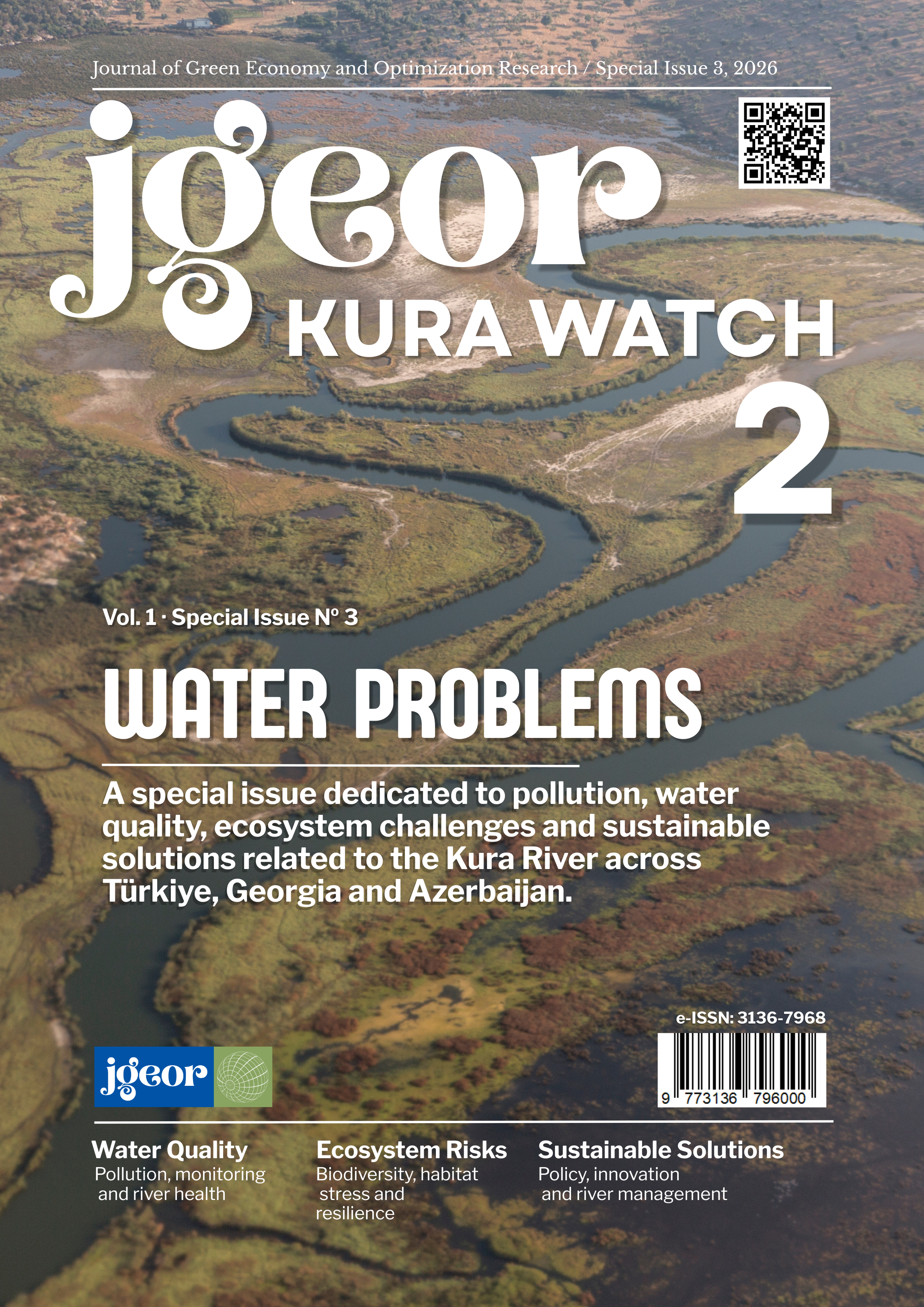
Downloads
Published
Issue
Section
Categories
License
Copyright (c) 2026 Journal of Green Economy and Optimization Research

This work is licensed under a Creative Commons Attribution 4.0 International License.
Copyright © The Author(s).
Authors retain copyright in their work and grant the Journal of Green Economy and Optimization Research (JGEOR) the right of first publication.
Articles published in JGEOR are distributed under the terms of the Creative Commons Attribution 4.0 International License (CC BY 4.0). This license permits use, sharing, adaptation, distribution, and reproduction in any medium or format, provided that appropriate credit is given to the original author(s) and the source, a link to the Creative Commons licence is provided, and any changes made are indicated.
Authors are responsible for obtaining permission to reproduce any third-party material that is not covered by the article's Creative Commons licence.