
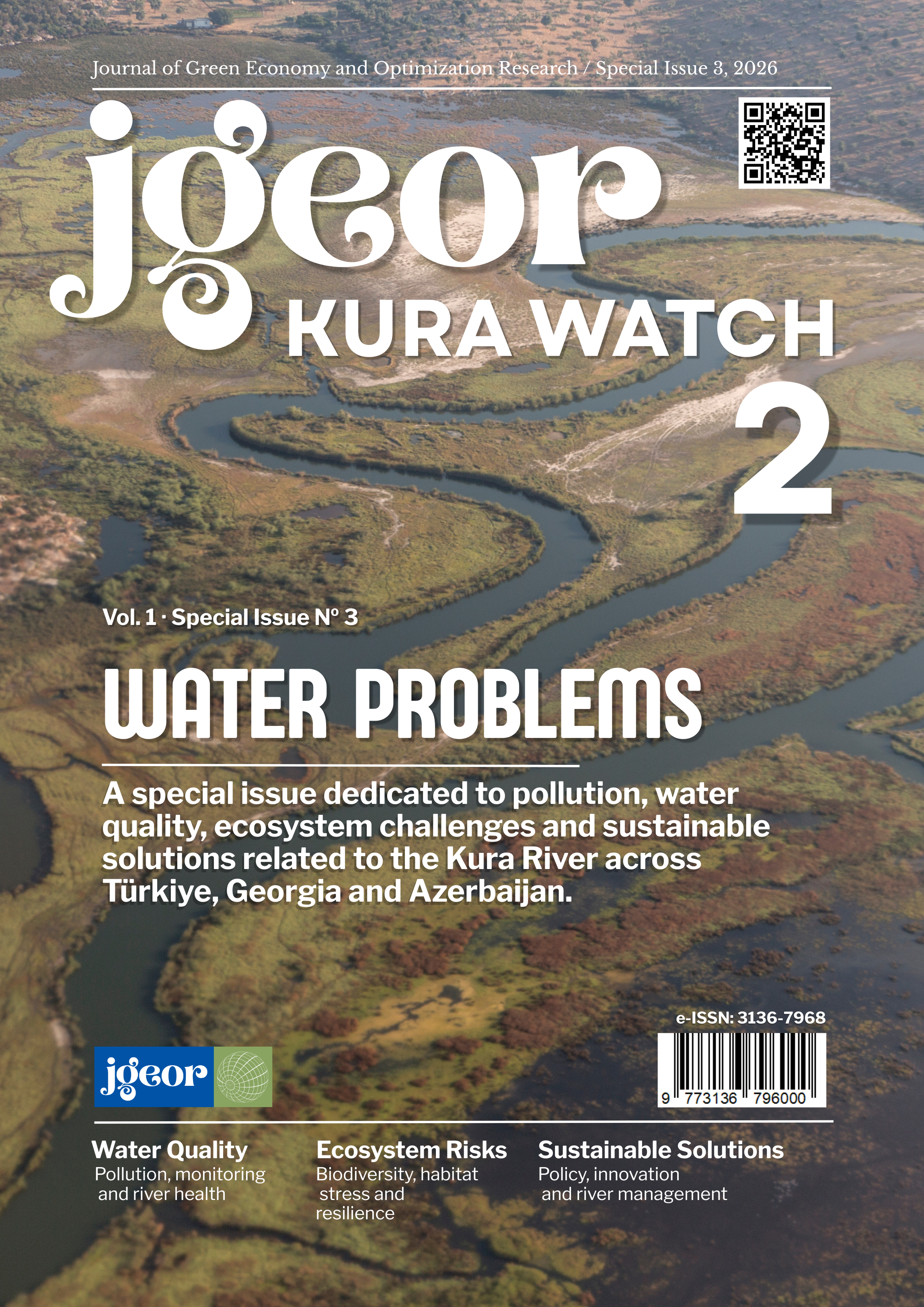
Ecological pressures on the Kura River and sustainable pathways for pollution control, water conservation and biodiversity protection
DOI:
https://doi.org/10.68210/jgeor.a82Keywords:
Kura River, water quality, water security, biodiversity, green economyAbstract
The Kura River is a transboundary freshwater system linking upstream, middle-basin and downstream communities, agriculture, infrastructure and ecosystems across the South Caucasus. This study restructures and extends an original educational research project on the ecological problems of the Kura River while preserving its central themes, visual materials, tables and ten-question survey instrument. The source project identified three interrelated pressure groups: water-quality deterioration and transboundary pollution, declining water availability and hydrological alteration, and biodiversity loss associated with habitat change, river regulation and riparian degradation. The present article evaluates these themes through a structured narrative review supported by recent monitoring, biodiversity, water-security and green-economy literature. The analysis confirms that water quantity and water quality should be assessed separately but jointly, because usable water can decline through both reduced availability and deteriorating chemical or ecological condition. Recent Kura monitoring shows longitudinal changes in major-ion composition, while regional studies identify anthropogenic pressure, altered hydrology and riparian degradation as important ecosystem concerns. The original project’s proposed solutions—water conservation, efficient irrigation, wastewater treatment, rainwater harvesting, reuse, riverbank clean-up, ecological education and transboundary monitoring—are reframed as elements of integrated and circular water management. The article concludes that Kura River protection requires coordinated monitoring, pollution prevention, resource-efficient water use, nature-based restoration and biodiversity-sensitive river management, with future research based on traceable datasets and repeatable field measurements.
Downloads
References
Aliyev, E., & Abduyev, M. (2025). Quality trend of Kura River in Azerbaijan by major ion concentration. Discover Water, 5, 82. https://doi.org/10.1007/s43832-025-00219-9
Arifzade, E. (2026). Hydroecological pressure signals in Mingachevir Reservoir: A retrospective synthesis of nutrient, microbial and major-ion evidence from the Middle Kura cascade. Journal of Green Economy and Optimization Research, 1(Special Issue 2), 46–50. https://doi.org/10.68210/jgeor.a52
Baytaşoğlu, H. (2023). Evaluation of the water quality of Kura-Aras River basins, transboundary rivers of Türkiye, according to some biotic indices. Journal of Anatolian Environmental and Animal Sciences, 8(3), 474–483. https://doi.org/10.35229/jaes.1331904
Gurbanov, E., Talibov, T., Novruzov, V., Bayramova, A., Ahmadova, N., Bayramova, U., & Aslanova, S. (2026). Riparian Tugai forest ecosystems of Azerbaijan: Vegetation structure, classification and ecological characteristics. Diversity, 18(7), 441. https://doi.org/10.3390/d18070441
Mammadov, U., Namazova, T., & Ahmadova, N. (2026). Microplastic pollution and coastal anthropogenic pressure in the Caspian Sea Basin through systematic review and secondary data analysis. American Journal of Energy and Natural Resources, 5(1), 54–64. https://doi.org/10.54536/ajenr.v5i1.8234
President of the Republic of Azerbaijan. (2024). National Strategy on the Efficient Use of Water Resources for 2024–2040. https://president.az/az/articles/view/67069
Qadimli, N., & Mammadov, U. (2026a). Assessing ecosystem sustainability and green finance-based ecotourism opportunities in Akhar-Bakhar National Park. Journal of Green Economy and Optimization Research, 1(1). https://doi.org/10.5281/zenodo.21921560
Qadimli, N., & Mammadov, U. (2026b). Remote sensing assessment of nature-based solution priorities and green finance needs for ecosystem restoration in Shahdag National Park. Journal of Green Economy and Optimization Research, 1(Special Issue 1), 19–30. https://doi.org/10.5281/zenodo.22130333
Qadimli, N., Mammadov, U., Hasilov, E., & Yagublu, U. (2026). Spatial assessment of blue-green tourism potential and sustainable development priorities in the Central Aran economic region of Azerbaijan. Journal of Green Economy and Optimization Research, 1(Special Issue 1), 84–89. https://doi.org/10.68210/jgeor.a39
United Nations Economic Commission for Europe. (n.d.). Projects in Caucasus: Transboundary water cooperation in the Kura River basin. https://unece.org/environment-policy/water/areas-work-convention/projects-caucasus
World Bank Group. (2024). Azerbaijan: Transitioning to efficient water sector institutions and programs for addressing water security challenges. World Bank.
Aliyev, S., Farzali, S., & Dürrani, Ö. (2023). Spatial and temporal variations in the environmental and biological characteristics of the Turyanchay River basin, Azerbaijan. Journal of Freshwater Ecology, 38(1), 2221074. https://doi.org/10.1080/02705060.2023.2221074
Gurbanov, E., & Ahmadova, N. (2024). The phytoecological characteristics and restoration of riparian forests along the Kura River in the territory of the Agjabadi District. Acta Botanica Caucasica, 3(1), 3–7. https://doi.org/10.30546/abc.2024.3.1.301
Downloads
Published
Issue
Section
Categories
License
Copyright (c) 2026 Journal of Green Economy and Optimization Research

This work is licensed under a Creative Commons Attribution 4.0 International License.
Copyright © The Author(s).
Authors retain copyright in their work and grant the Journal of Green Economy and Optimization Research (JGEOR) the right of first publication.
Articles published in JGEOR are distributed under the terms of the Creative Commons Attribution 4.0 International License (CC BY 4.0). This license permits use, sharing, adaptation, distribution, and reproduction in any medium or format, provided that appropriate credit is given to the original author(s) and the source, a link to the Creative Commons licence is provided, and any changes made are indicated.
Authors are responsible for obtaining permission to reproduce any third-party material that is not covered by the article's Creative Commons licence.