Mother Kura - comprehensive information about the Kura River
DOI:
https://doi.org/10.68210/jgeor.a84Keywords:
Kura River, natural capital, water security, ecosystem services, sustainable river managementAbstract
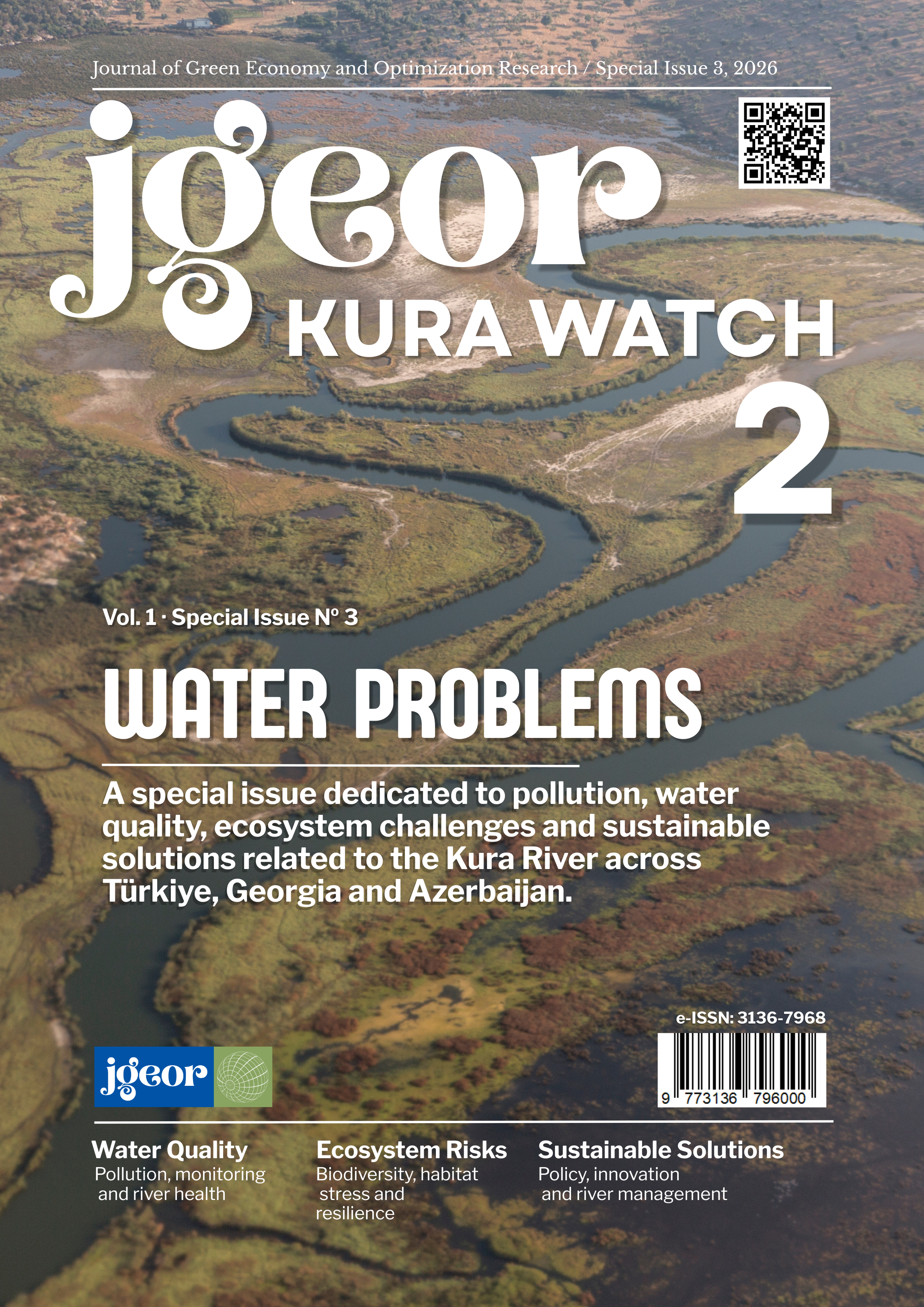
The Kura River is a transboundary river system that links geography, biodiversity, settlement, agriculture, water supply, hydropower, cultural history and environmental management across the South Caucasus. This article develops the submitted “Mother Kura” educational research document into a structured interdisciplinary review while preserving its original organization around geographical location, tributaries, natural features, economic importance, historical significance and conservation. The analysis uses secondary-source synthesis to examine the river from its headwaters in Türkiye through Georgia and Azerbaijan to the Caspian Sea, with particular attention to the Azerbaijani section and the Mingachevir water management system. The review shows that the river’s value extends beyond direct water extraction. Riparian habitats, fish and waterbirds, irrigation, hydropower, drinking-water supply, settlement and landscape identity form an interconnected socio-ecological system. Environmental pressures include untreated wastewater, agricultural runoff, solid waste, excessive withdrawal, hydrological alteration, drought and habitat degradation. These pressures can reduce both ecological integrity and economic resilience by weakening ecosystem services and increasing water-management costs. The paper interprets the Kura as natural capital within a green-economy framework and identifies efficient irrigation, water-quality monitoring, wastewater treatment, riparian restoration, data sharing and environmental education as complementary responses. The study concludes that long-term protection of the Kura requires integrated basin management that connects historical and cultural value with present-day water security, ecosystem sustainability and future-oriented economic development.
Downloads
References
Aliyev, E., & Abduyev, M. (2025). Quality trend of Kura River in Azerbaijan by major ion concentration. Discover Water, 5, Article 82. https://doi.org/10.1007/s43832-025-00219-9
Arifzade, E. (2026). Hydroecological pressure signals in Mingachevir Reservoir: A retrospective synthesis of nutrient, microbial and major-ion evidence from the Middle Kura cascade. Journal of Green Economy and Optimization Research, 1(Special Issue 2), 46–50. https://doi.org/10.68210/jgeor.a52
Flores, M., & Abbasov, R. (2015). Assessment of the contribution of freshwater ecosystem services to the hydropower sector in the Kura-Aras River Basin in Azerbaijan. WWF Caucasus Programme / United Nations Development Programme.
Ismayilova, N. (2024). The Kura-Araxes culture in Azerbaijan and its wider regional context in the Caucasus [Doctoral dissertation, University of Birmingham]. University of Birmingham Research Archive.
Kohl, P. L. (2009). Origins, homelands and migrations: Situating the Kura-Araxes Early Transcaucasian “culture” within the history of Bronze Age Eurasia. Tel Aviv, 36(2), 241–265. https://doi.org/10.1179/033443509X12506723940686
Mammadov, U., Namazova, T., & Ahmadova, N. (2026). Microplastic pollution and coastal anthropogenic pressure in the Caspian Sea Basin through systematic review and secondary data analysis. American Journal of Energy and Natural Resources, 5(1), 54–64. https://doi.org/10.54536/ajenr.v5i1.8234
Qadimli, N., & Mammadov, U. (2026a). Assessing ecosystem sustainability and green finance-based ecotourism opportunities in Akhar-Bakhar National Park. Journal of Green Economy and Optimization Research, 1(1). https://doi.org/10.5281/zenodo.21921560
Qadimli, N., & Mammadov, U. (2026b). Remote sensing assessment of nature-based solution priorities and green finance needs for ecosystem restoration in Shahdag National Park. Journal of Green Economy and Optimization Research, 1(Special Issue 1), 19–30. https://doi.org/10.5281/zenodo.22130333
Qadimli, N., Mammadov, U., Hasilov, E., & Yagublu, U. (2026). Spatial assessment of blue-green tourism potential and sustainable development priorities in the Central Aran economic region of Azerbaijan. Journal of Green Economy and Optimization Research, 1(Special Issue 1), 84–89. https://doi.org/10.68210/jgeor.a39
United Nations Development Programme. (n.d.). Targeted scenario analysis: Assessment of the contribution of freshwater ecosystem services to the hydropower sector in the Kura-Aras River Basin in Azerbaijan.
United Nations Economic Commission for Europe. (2026). Azerbaijan: National Policy Dialogue on integrated water resources management. UNECE.
United Nations Economic Commission for Europe. (n.d.). Projects in Caucasus: Transboundary water cooperation and the Kura River Basin. UNECE.
Wordsworth, P. (2021). Kura River. Encyclopaedia Iranica.
Downloads
Published
Issue
Section
Categories
License
Copyright (c) 2026 Journal of Green Economy and Optimization Research

This work is licensed under a Creative Commons Attribution 4.0 International License.
Copyright © The Author(s).
Authors retain copyright in their work and grant the Journal of Green Economy and Optimization Research (JGEOR) the right of first publication.
Articles published in JGEOR are distributed under the terms of the Creative Commons Attribution 4.0 International License (CC BY 4.0). This license permits use, sharing, adaptation, distribution, and reproduction in any medium or format, provided that appropriate credit is given to the original author(s) and the source, a link to the Creative Commons licence is provided, and any changes made are indicated.
Authors are responsible for obtaining permission to reproduce any third-party material that is not covered by the article's Creative Commons licence.